
Your Guide Through Medicare’s Maze We make sense of the complexities to help you make sensible decisions.
If you're turning 65 or already 65 and about to retire, you will have some critical decisions to make soon. We're here to guide you through the Medicare maze and help you find a plan that fits your needs. As you begin your Medicare process it is important to understand what Original Medicare covers. Or, maybe more importantly, what it doesn't cover.
Understanding Medicare
Medicare can be confusing, but don't worry – we've got you covered. Medicare is a federal health insurance program for individuals who are 65 years or older, or those with certain disabilities. Often referred to as Original Medicare, it consists of Part A and Part B.
Part A covers hospital stays, skilled nursing facility care, hospice care and some home health care.
Part B covers doctor visits, outpatient care, medical supplies and preventive services.
Understanding how Medicare works and finding the right plan for you gives you access to the health care services you need as you age, providing financial protection and confidence.


Original Medicare
Part A
Medicare Part A is your hospitalization. It also covers skilled nursing, home health care and hospice care.
Part A generally comes at no cost to individuals who have paid Medicare taxes while working. However, there may be costs associated with certain services, such as deductibles and coinsurance.
Original Medicare
Part B
Medicare Part B covers your outpatient needs, including visits to your primary care doctor, specialists, outpatient procedures, emergency room visits, etc. It often is referred to as an 80-20 plan, meaning Medicare pays 80% of your outpatient costs and you pay 20%.
Part B requires a monthly premium and an annual deductible. In 2026, the premium for most people is $202.90 while the deductible is $283.


Is Original Medicare Enough?
Navigating Medicare is like solving a puzzle. The central question: Is Original Medicare enough?
While Parts A and B provide foundational coverage, they do not meet all needs in your retirement years. Most people find that you are far better off – and far more at ease – by adding a Medicare Supplement plan or choosing a Medicare Advantage plan.
We work closely with clients just like you to help you determine which type of plan works for you. Our personalized approach considers coverage gaps and a variety of strategies that align with your priorities and goals.
How Much Will You Pay for Medicare?
Your Medicare premiums depend on your income-related monthly adjustment amount, or IRMAA. Most Medicare beneficiaries pay the standard monthly premium for Medicare Part B. But if your income is above certain thresholds, you may be required to pay a higher premium for both Medicare Parts B and D.
To determine IRMAA, Medicare looks at your income from two years prior and uses that figure to establish your monthly premium. For example, 2026 Medicare premiums were based on income reported on 2024 tax returns.
Higher-income Medicare beneficiaries may fall into one of five IRMAA brackets, with the amount you pay increasing as your income increases. Here’s how it looked in 2026:
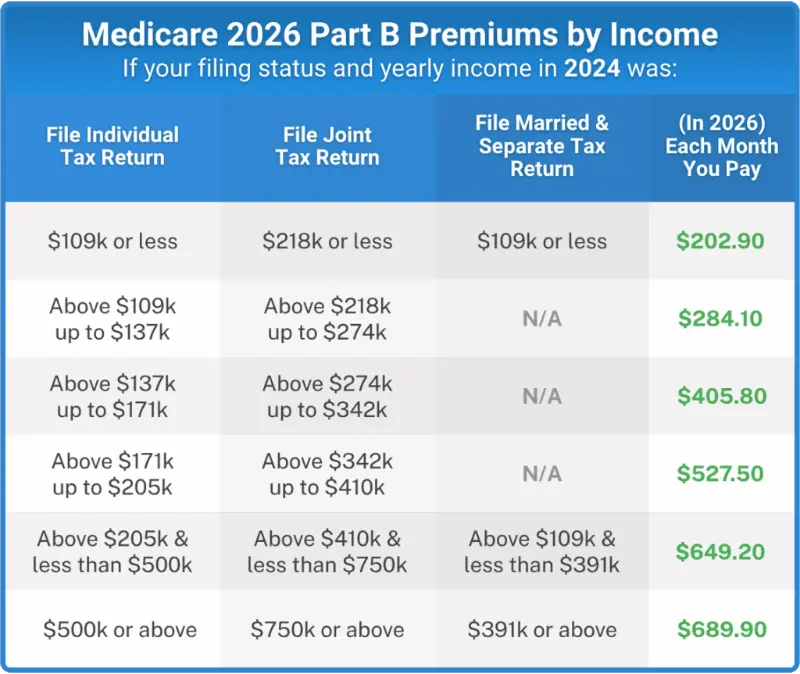
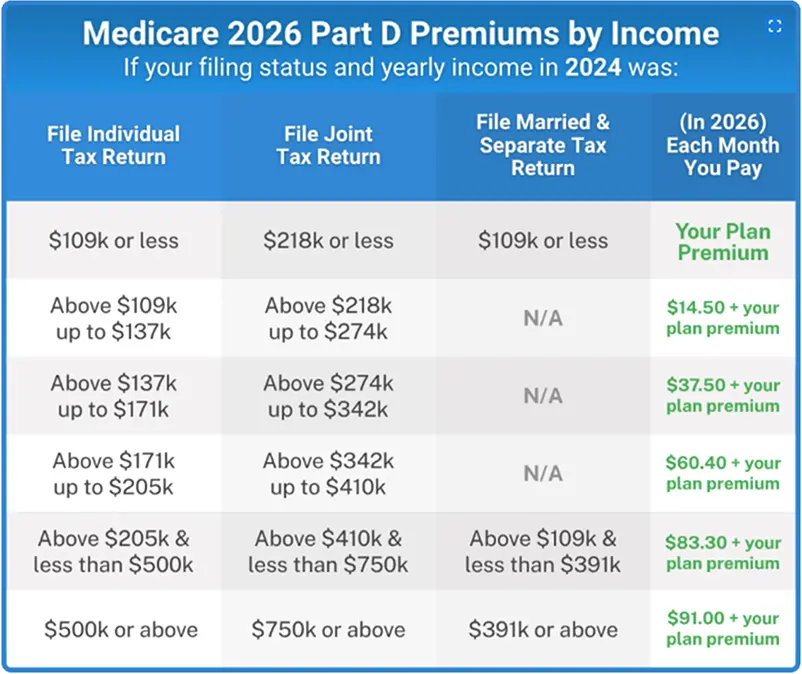
The good news is that IRMAA isn’t necessarily permanent. Your premium is reviewed each year and adjusted based on your income from two years earlier. If your income decreases, your Medicare premiums may decrease as well.
In certain situations, you may not have to wait for that two-year lookback to catch up. If your income has dropped due to a qualifying life-changing event — such as retirement or a reduction in work — you may be able to appeal your IRMAA determination and ask Social Security to use a more recent estimate of your income.
Check out our video to learn more about IRMAA and the possibility of contesting your increase.
Popular Medicare Supplement Plans Medicare Supplement Plan F
As far as coverage goes, Plan F is very simple to explain. It fills all the gaps!
When you combine a Plan F with Medicare, you have no network and no out-of-pocket exposure. All you will receive in the mail is a statement of benefits paid.
But here’s the catch: Plan F was so popular that the government discontinued it, making it no longer available to new Medicare beneficiaries after January 2020. Only those grandfathered into the plan can continue using Supplement Plan F.
